The Monster in the Mirror: How Rock's Darkest Personas Stay Anchored to the Human Underneath
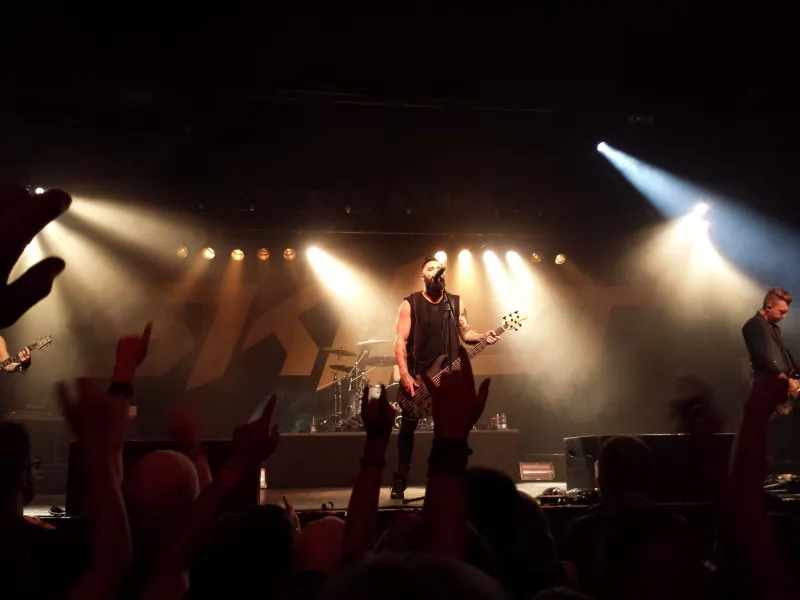
The Monster in the Mirror: How Rock's Darkest Personas Stay Anchored to the Human Underneath
There's a version of this story where it's simple. Rock star wants to seem dangerous, rock star puts on some face paint, rock star sells records. End of story.
But that's not actually how it works — not when it's done right, anyway. The musicians who built genuinely unsettling stage personas didn't just slap on a mask and call it a night. They went digging. Deep into whatever was already living inside them, already knocking around in the dark, and they gave it a name, a look, and a microphone. The result wasn't a costume. It was a confession.
That's the real double life dilemma: how do you construct something monstrous without losing track of yourself in the process?
Vincent Price Meets the Midwest Kid
Start with Alice Cooper — and we mean the name, not the man. Vincent Damon Furnier grew up in Phoenix, Arizona, the son of a preacher. He was an awkward kid who loved horror movies and the Marx Brothers in equal measure. When the band started developing what would become the Alice Cooper persona in the late '60s, it wasn't a marketing strategy. It was Furnier pouring everything he found genuinely fascinating — old Hollywood horror, vaudeville darkness, American carnival tradition — into a single theatrical vessel.
The key thing people miss about Alice Cooper is how specific it was. This wasn't generic evil. It was a character with a backstory, a set of obsessions, a particular flavor of American grotesque. Furnier could walk offstage, sit down with a journalist, crack jokes about golf, and be completely himself — because Alice was never pretending to be him. They were two distinct entities sharing a body, and both of them were real in their own way.
That's the first rule of the double life: the persona has to be specific enough to have its own logic, its own internal truth. Vague darkness is just theater. Specific darkness is something else entirely.
When the Mask Fits Too Well
Marilyn Manson took the blueprint and pushed it somewhere considerably more uncomfortable. Brian Warner was a music journalist in Fort Lauderdale before he became the most controversial rock figure of the '90s. He understood, maybe better than anyone at the time, that the persona needed to be a provocation — not just to audiences, but to the culture itself.
The Manson character was constructed as a kind of American nightmare collage: equal parts glam rock decadence, religious anxiety, and suburban dread. It was designed to make people deeply uneasy, and it worked spectacularly. Congressional hearings, parental outrage, the whole circus. But what made it genuinely dangerous as an artistic exercise was that Warner wasn't entirely separate from the thing he'd built. He's talked openly about how the persona became a way to process real trauma, real alienation, real fury at American cultural hypocrisy.
That's where the double life gets complicated. When the persona is a genuine psychological outlet — not just a performance but a pressure valve — the line between character and self starts to blur. Some artists navigate that blur brilliantly. Others get lost in it. The difference usually comes down to whether the person underneath the persona has a stable enough foundation to keep their footing when things get weird.
The Tightrope Act in Real Time
Gene Simmons of KISS built The Demon as something almost mythological — a creature from another world, fire-breathing and impossible. But Simmons the businessman, the negotiator, the guy who trademarked his own tongue gesture, was always very much present and very much in control. The persona was a vehicle, not a destination. He rode it to extraordinary places without ever confusing himself for the character.
David Bowie's Ziggy Stardust represents maybe the most studied example of this tightrope act, and also the most cautionary. Ziggy was so vivid, so complete, so consuming that Bowie eventually had to kill him — literally staging a public retirement of the character in 1973 — because the line between David Jones and Ziggy Stardust had become genuinely dangerous to his sense of self. He's described that period as one of the most psychologically disorienting of his life. The persona had started to eat the person.
What saved him was the same thing that saves every artist who survives this particular game: the ability to step back, recognize what's happening, and make a deliberate choice about where the character ends and the human begins.
What Makes the Darkness Real
Here's the thing that separates a truly compelling villainous rock persona from a Halloween costume with a record deal: authenticity of source material. The darkness has to come from somewhere genuine.
When it works — when you watch Alice Cooper stalk a stage with a boa constrictor, or see Manson deliver a performance that makes an entire arena genuinely uncomfortable — what you're reacting to isn't just spectacle. You're reacting to something real that's been shaped and amplified and given a theatrical framework. The menace is borrowed from actual human experience and then turned up to eleven.
American rock has always understood this intuitively, even when it couldn't articulate it. From the Delta blues tradition that rock grew out of — where Robert Johnson sold his soul at the crossroads, or at least was happy to let people believe he did — to the shock rock of the '70s and the industrial-influenced darkness of the '90s, the through-line is always the same. The most effective personas aren't inventions. They're amplifications.
Staying Human in the Villain's Clothes
So how do the ones who make it actually do it? How do you spend decades embodying something dark and dangerous without losing yourself in the process?
Talk to most of these artists offstage and a few things become clear pretty quickly. They tend to have a strong sense of humor about the whole thing — which makes sense, because humor requires distance, and distance is exactly what keeps you from disappearing into your own mythology. They have lives outside the persona: families, hobbies, obsessions that have nothing to do with the character they play for a living. And they tend to be remarkably clear-eyed about what the persona is and what it isn't.
Alice Cooper plays golf. Gene Simmons collects memorabilia. Rob Zombie directs horror films that are, in their own way, as carefully crafted as anything he does on a stage. These aren't contradictions. They're anchors.
The double life works when both lives are genuinely lived. The villain on the stage is real — but so is the person who goes home afterward, orders a pizza, and watches bad TV. Keeping that person intact isn't weakness. It's the whole point.
Because the monster in the mirror is only interesting if there's a human being doing the looking.