Broke and Brilliant: The Rock Records Born From Rock Bottom

There's a version of the rock 'n' roll story that gets told in documentaries and glossy magazine retrospectives, the one where the band finds success, books the big studio, and makes the classic album with a legendary producer at the board and unlimited time on the clock.
And then there's the other version. The one where the van broke down in Ohio and nobody has the money to fix it. Where the label dropped the band six weeks before the record was due. Where the drummer is sleeping on a friend's couch in a city where they don't know anyone, and the singer is writing lyrics on the back of a gas station receipt because that's the only paper available.
That second version produces better albums more often than anyone wants to admit.
When There's Nothing Left to Protect
The relationship between financial desperation and creative honesty is one of the most consistent patterns in rock history, and it makes a certain kind of sense when you think about it. Comfort has a way of making artists careful. When you have something to lose — a deal, a reputation, a lifestyle — you start making decisions based on what you might lose rather than what you're actually trying to say.
Strip all of that away, and the calculus changes completely. A band with empty pockets and no label breathing down their neck has nothing to be careful about. They can be as raw, as weird, as uncommercial, as brutally honest as the music demands. Nobody is waiting to greenlight the next single. There's no marketing strategy to protect. There's just the songs and whatever's left of the people who wrote them.
Springsteen and the Wall With No Door
Bruce Springsteen's Nebraska (1982) is one of the great examples of economic and professional pressure producing something genuinely extraordinary — though in Springsteen's case the pressure was more internal than financial. After the commercial explosion of The River, the expectation was a follow-up that would consolidate and expand. Instead, Springsteen recorded a collection of stark, devastating acoustic demos on a four-track Tascam in his bedroom in New Jersey, songs populated by criminals, drifters, and people for whom the American Dream had already closed its doors.
The E Street Band attempted to flesh the songs out. It didn't work. The demos were the album. Released with almost no commercial infrastructure and minimal radio play, Nebraska became one of the most critically revered records of the decade — precisely because it sounded like someone who had decided to stop caring whether it worked.
The Replacements and the Art of the Spectacular Stumble
Few bands embodied the broke-and-ragged aesthetic more completely than The Replacements, the Minneapolis quartet who spent most of the early 1980s oscillating between moments of transcendent songwriting and performances so chaotic they bordered on self-sabotage. Paul Westerberg was writing some of the most emotionally honest rock songs of his generation while the band was surviving on next to nothing, playing bars in the Midwest for crowds that sometimes numbered in the dozens.
Let It Be (1984) — recorded on a shoestring and named after the Beatles record with a casualness that was either brilliant or oblivious — captured a band at the exact moment when desperation and talent collided at the right angle. The album's emotional openness, the sense that nothing was being held back because there was nothing left to hold, is inseparable from the circumstances that produced it.
The Replacements were never quite the same once they got a bigger budget and a major label deal. That's not a coincidence.
Van Life Is Not Romantic When It's Not a Choice
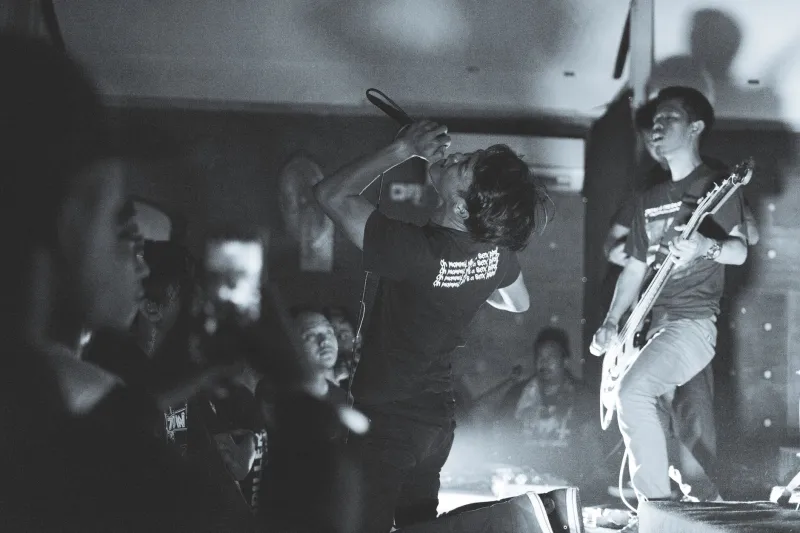
Anyone who's spent time on the road with a rock band knows that the van-and-ramen mythology sounds better in retrospect than it feels in the moment. When you're three weeks into a tour that's losing money, sleeping in a vehicle that smells like amplifier sweat and fast food wrappers, playing to indifferent Tuesday night crowds in towns where nobody knows your name — that's not a romantic adventure. That's survival.
But something happens to the music in those conditions. The performances get sharper, more urgent, because there's no cushion. Every show might be the last one if the money doesn't come through. Every song has to count in a way it doesn't when the tour is profitable and the label is happy and everyone's staying in actual hotels.
Bands who've come up through that particular crucible often describe it later as the period when they found out what they actually were. The comfort gets stripped away and what's left is either something real or nothing at all.
Hüsker Dü and the Sound of the Engine Burning
Hüsker Dü's Zen Arcade (1984) was recorded in thirty-five hours for a budget so minimal it barely registered. The Minneapolis hardcore trio had been grinding through the underground circuit for years, releasing records on their own label, building an audience through sheer relentless touring. Zen Arcade was a double album — ambitious to the point of absurdity given their resources — and the limitations of the recording are audible throughout. The drums sound like they're being played in a closet. The mix is rough. None of that matters, because the performances are so alive and so desperate that the technical imperfections become part of the texture.
You can't manufacture that quality in a well-funded studio. It comes from a band that has nothing to fall back on and knows it.
The Paradox That Keeps Proving Itself
The pattern is so consistent across rock history that it starts to feel like a law of physics: remove the resources, remove the safety net, remove the commercial expectations, and the music gets more honest. Not always better in a technical sense. But more honest. More urgent. More like something that had to be made rather than something that was carefully produced.
For any band out there right now running on fumes and determination — playing the small rooms, watching the van's check engine light flicker on for the third time this month, wondering if any of this is going to work — take some comfort in the company you're keeping. Some of the records that mattered most were made by people in exactly that position.
The desperation is in the grooves. That's why it still sounds true.